
The Architecture of False Promise
The recruitment funnel of a digital platform is masterfully constructed. The advertisements are optimistic, often spectacular — full of smiling faces, flexible schedules, and income projections that feel within reach. The language of the onboarding process is deliberately simplified: "Join in three minutes." "Start earning today." What these campaigns never reveal is the compliance maze that lies one step beyond the sign-up button.
A job seeker, drawn in by the promise, creates an account. Only then does the first gate appear: submit this document. She complies. Another gate: complete this verification. She complies again. A third requirement materialises, then a fourth — each one revealed only after the previous has been satisfied, like a corridor where every door conceals another door. She is now invested — emotionally and financially — and the platform knows it.
This graduated disclosure of requirements is not a design accident. It is, at best, a failure of transparency; at worst, a deliberate strategy. By the time a contributor realises the full extent of what is demanded — multiple government identity documents, financial records, tax compliance forms, bank account verification, and in some cases fees simply to begin working — they are already deeply embedded in the system. Walking away means losing what they have already invested.
The Identity Extraction Machine
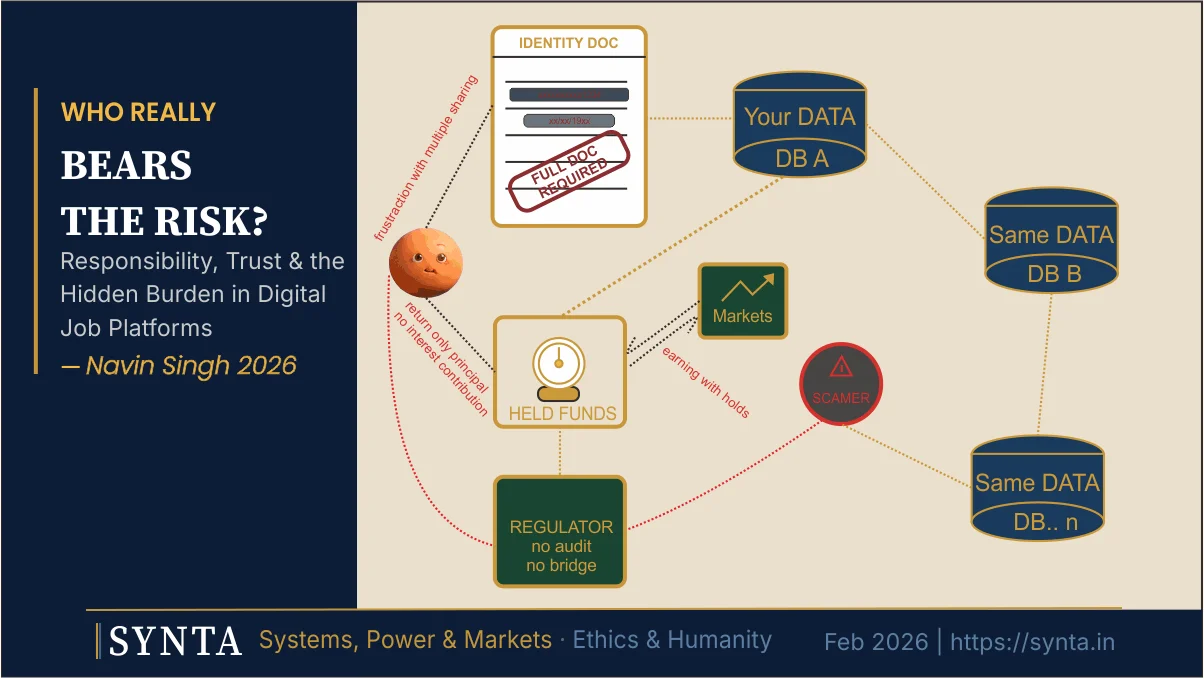
One of the most striking features of modern digital platforms is their appetite for identity documents. A contributor is often asked to submit a national identification card, a passport, a tax identification number, a bank statement, a utility bill, and sometimes more. Each document represents not just personal information, but a window into the most private dimensions of a person's life — their address, their finances, their legal identity.
The stated justification is always fraud prevention and regulatory compliance. And in part, this is legitimate. Identity verification serves a genuine purpose. But two questions remain consistently unasked and unanswered: How much verification is actually necessary? And who is truly responsible for the security of this data once it is collected?
Many governments have introduced the concept of a masked or partially redacted identity document — one where the majority of a sensitive identification number is obscured, revealing only enough for verification purposes. This is not a loophole. This is a deliberate policy designed to protect citizens. Yet many platforms explicitly refuse to accept masked documents. In doing so, they not only ignore the spirit of data minimisation laws, they may well be in breach of them. One must ask: if a government regulator has defined a masked document as legally sufficient, on what authority does a private platform demand the full original?
The problem is compounded in multi-stakeholder ecosystems. A contributor registers with Platform A, which partners with a payment processor B and a fulfilment partner C. Each partner independently conducts their own KYC process, extracting the same sensitive documents multiple times across three separate databases with three separate security postures. The contributor's data now lives in at least three places — and she has no visibility into how any of them store it, secure it, or share it.²
Fragmented Responsibility, Concentrated Risk
The multi-party structure of digital platforms is frequently presented as an advantage — specialisation, efficiency, seamless integration. But from the perspective of the contributor, it is often experienced very differently: as a fragmentation of accountability that leaves no single party fully responsible for the contributor's experience.
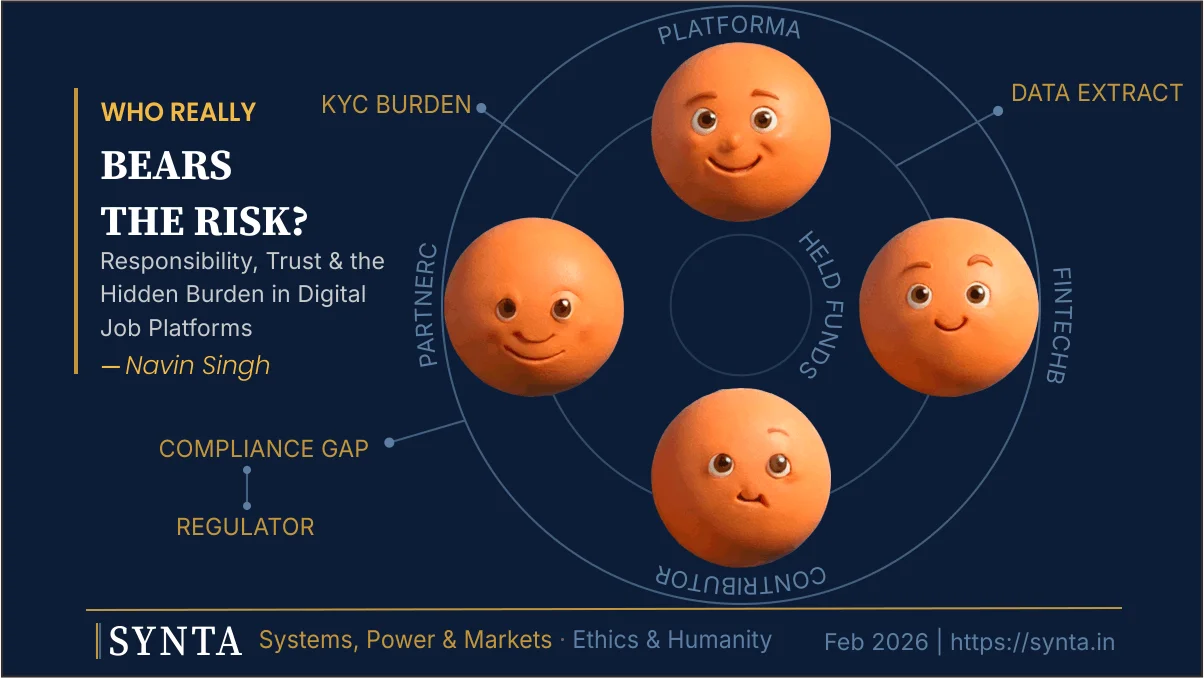
Consider the mechanics of a typical arrangement: Company A recruits contributors through bold advertising. It is the face of the relationship — the name on the app, the brand the contributor trusts. But Company A does not handle payments; that is the domain of FinTech Partner B. And Company A does not manage fulfilment; that belongs to Partner C. Each of these entities has its own compliance requirements, its own document demands, its own delays and processes.
When something goes wrong — when a payment is delayed, when an account is suspended, when a document is rejected — the contributor contacts Company A. Company A refers her to Partner B. Partner B informs her that the issue lies with Partner C. She is passed around a triangular system in which none of the three corners feels obliged to take ownership. The contributor, who came to the platform simply to work and earn, now finds herself managing a multi-vendor dispute resolution process for which she has neither the time nor the expertise.
This is not a systems failure. It is a structural choice — and it is a choice that consistently benefits the platform while consistently burdening the contributor. If companies A, B, and C have committed to one another through partnership agreements and integrated APIs, they have the technical and contractual capability to create a unified compliance experience. The decision not to do so is a policy decision, not a technical one. And the consequences of that decision are borne entirely by the people at the base of the chain.
The Long Shadow of the Compliance Document
Platform terms of service and compliance agreements have grown, over time, into monuments of impenetrability. Documents stretching to thirty, fifty, sometimes a hundred pages, written in dense legal language, riddled with cross-references and subordinate clauses that would challenge a trained lawyer — these are presented to ordinary contributors as a simple checkbox: "I agree."
Research consistently shows that the overwhelming majority of users do not read terms of service agreements. This is not a reflection of their intelligence or diligence. It is a rational response to an impossible task. A contributor who has just finished a twelve-hour work day, who is trying to earn enough to pay her rent, cannot be expected to parse thirty pages of legal text before clicking submit. The system knows this. In many cases, the system relies on it.
Hidden within these documents — buried in sub-clauses and appendices — are provisions that have significant financial consequences: clauses that permit the platform to withhold payments for indeterminate periods under undefined "review" processes; clauses that allow the platform to terminate accounts without appeal; clauses that waive the contributor's right to interest on held funds; clauses that shift liability for data breaches onto the contributor herself. These are not exceptional provisions. They are common.
The question that must be asked — and that regulators have consistently failed to ask — is whether such agreements are genuinely consensual. If one party to a contract lacks the resources to understand what she is agreeing to, and if the other party is aware of and exploits this asymmetry, the notion of informed consent becomes a legal fiction. The "agreement" is not an agreement. It is a document of submission dressed in the language of choice.
A platform that is genuinely committed to fairness would do one of two things: either simplify its compliance documentation to the point where an ordinary person can understand it without legal assistance, or provide that legal assistance freely. Until one of these conditions is met, complexity in documentation must be recognised for what it is — not a protection for the platform, but a weapon against the contributor.⁴
The Hidden Cost of Holding Funds
Perhaps nowhere is the asymmetry of the platform economy more starkly visible than in the practice of withholding earnings. Across the digital gig economy, it is routine for platforms to delay payment to contributors — sometimes for days, sometimes for weeks, sometimes for months — under the umbrella of compliance review, dispute resolution, or identity verification processes.
To the platform, a held payment is a minor administrative matter, a line in a ledger. To the contributor, it may be the difference between paying rent and eviction, between buying medicine and illness, between honouring a debt and default. She is not waiting for a discretionary bonus. She is waiting for wages already earned. The fact that the money exists, is acknowledged to exist, and is simply being withheld, does not make the wait any less financially devastating.
Now consider the economics from the other side. A platform that holds millions of dollars in contributor earnings, across hundreds of thousands of accounts, for periods of two to four weeks, is effectively in possession of an interest-free float. In an environment where financial instruments offer returns, this float is not merely convenient — it is profitable. The platform earns on money it is holding on behalf of contributors who are earning nothing on it.
Banking institutions — institutions that are, in every other context, regarded as the most conservative and least generous of creditors — calculate interest on every loan from the first day. A borrower who is one day late in repayment is charged accordingly. The standard of reciprocity demands the same be applied in reverse: a platform that withholds a contributor's earned income must be obligated to pay interest on that holding, calculated from the day the income was earned. Anything less is a subsidy extracted from contributors to fund platform operations.
The Data Security Paradox
The contributors of the digital economy are, in a meaningful sense, among the most surveilled workers in history. The platforms that employ them know where they are, when they work, how much they earn, what documents they hold, and what accounts they use. This depth of data collection is justified, repeatedly, in the name of security and fraud prevention.
Yet the very depth of this collection creates a risk that no amount of perimeter security can fully eliminate: the insider threat. Large organisations, by their nature, employ large teams. Background checks catch some bad actors; they do not catch all of them. A person can pass every screen at the point of hiring and become a threat years later. A disgruntled employee, a compromised contractor, an individual in financial difficulty — any one of these can become a channel through which sensitive contributor data flows to those who would exploit it.
When this happens — and historical evidence from every industry suggests that it will happen — the contributor is the victim. Her identity documents are in the hands of scammers. Her financial data may be used to drain her accounts or open fraudulent credit lines in her name. The platform, by contrast, faces a reputational incident, an apologetic press release, perhaps a regulatory fine. The asymmetry of consequence is total: the contributor lives with the damage; the platform manages the story.
This is why the demand for full, unmasked government identity documents, across multiple company databases, is not merely excessive — it is irresponsible. The greater the quantity of sensitive data collected, the greater the surface area of risk. A platform that genuinely prioritised contributor protection would collect only what is strictly necessary, accept masked documents where regulation permits, implement rigorous and audited access controls, and accept legal liability for any breach that occurs within its ecosystem.
The Missing Bridge of Regulation
In every well-functioning society, there exists a compact between citizens, corporations, and the state. Citizens pay taxes. The state uses those taxes to build institutions — among them, regulators — that protect citizens from the predatory potential of corporations. This compact is not a favour granted by the state. It is the foundational justification for the state's authority to collect taxes in the first place.
By this standard, the regulatory compact in the digital economy has failed. Financial audits of platforms are regular and rigorous. Integrity audits — examinations of what data is being collected, from whom, for what purpose, how it is stored, and who has access to it — are rare to the point of non-existence in many jurisdictions. A platform can collect an extraordinary volume of sensitive personal data, retain it indefinitely, share it with undisclosed partners, and lose it to insider threats, all without meaningful regulatory consequence.
The gap between financial compliance and data integrity compliance is not an oversight. It reflects a regulatory culture that has prioritised the stability of financial systems over the protection of individual contributors. This is a choice, and it is a choice that can be reversed. Regulators have the authority to mandate unified KYC standards across partner ecosystems, to require that platforms demonstrate the legal sufficiency of masked document acceptance, to audit data retention and access policies, and to require platforms to maintain insurance funds that compensate contributors for breaches caused by platform negligence.
The relationship between citizens, regulators, and corporations must be reconfigured. Regulators must function not as distant authorities who periodically review balance sheets, but as active bridges — translating contributor rights into enforceable corporate obligations, and ensuring that the trust contributors place in platforms is backed by something more durable than a terms of service agreement.
A regulator funded by the taxes of contributors, who does not protect those contributors from exploitation, has inverted its own mandate. The compact must be restored.⁷
A Framework for Genuine Accountability
The problems described in this essay are structural, but they are not insoluble. They persist not because solutions are unavailable, but because the incentives of those with the power to change the system align against change. The following principles represent a minimum standard of genuine accountability — one that any platform claiming to offer fair opportunity must be willing to meet.
Full Pre-Commitment Disclosure: Every compliance requirement — documents, fees, verification steps, waiting periods, and conditions for account suspension — must be disclosed in full to a prospective contributor before they invest time or money in the onboarding process. Graduated disclosure that conceals requirements until after commitment is an unfair practice and must be prohibited.
Simplified Compliance and the Right to Understand: Every platform operating at scale must provide contributors with access to a plain-language summary of all compliance obligations. For complex or lengthy agreements, platforms must either simplify the document or provide free, independent legal guidance to help contributors make a fully informed decision.
Data Minimisation and Acceptance of Masked Documents: Where government regulators have defined masked or partially redacted identity documents as legally sufficient, platforms must accept them. Platforms must collect only the minimum data required, implement strict access controls, undergo regular integrity audits, and accept full liability for breaches arising from their data management practices.
Unified Partner KYC: If a platform depends on partners to deliver its service, it must absorb the compliance burden of those partnerships. A single KYC process — conducted once, recognised by all partners — must be the standard. The partnership agreement exists between companies; its compliance costs must not be offloaded onto contributors.
Interest on Held Funds: Any platform that withholds earned contributor income beyond a defined and reasonable review period must pay interest on that income, calculated from the date of earning, at a rate equivalent to the prevailing commercial bank lending rate.
Regulatory Integrity Audits: Government regulators must extend their audit frameworks beyond financial compliance to include data integrity, KYC proportionality, and contributor protection. The questions regulators must be able to answer include: What data is being collected? Is it proportionate to the stated purpose? Who has access? What are the consequences when it is breached?
Conclusion: Protecting the Engine
The digital platform economy is one of the most significant economic developments of our time. It has created new forms of work, extended economic participation to populations previously excluded from formal employment, and generated immense wealth. These are genuine achievements, and they should be recognised as such.
But the architecture of this economy has been built with a fundamental imbalance at its foundation. The people who generate the most value — the contributors, the creators, the workers — carry the greatest risks while enjoying the fewest protections. They are recruited through aspiration, bound through complexity, exposed through data extraction, and penalised through financial withholding. All of this occurs within a regulatory environment that has, until now, watched without intervening.
To speak of this imbalance is not to be anti-business. It is to insist on a simple and ancient principle: that those who profit from a system must bear a proportionate share of its risks. Platforms are not charities; they are businesses, and they deserve to operate profitably. But profit and fairness are not opposites. The most durable businesses in history have been those that treated their contributors — their workers, their partners, their communities — as assets worthy of protection rather than costs to be minimised.
Contributors are the golden asset of the platform economy. Without them, there are no transactions, no revenue, no growth. The measures outlined in this essay are not radical demands. They are the baseline conditions for a relationship that could, if properly structured, be genuinely and durably mutually beneficial.
The platform economy has the potential to be one of the most powerful engines of equitable prosperity the world has seen. But to fulfil that potential, it must first choose to protect the people who power it. Until that choice is made, the question posed in the title of this essay will have only one honest answer: the contributors bear the risk. All of it. And that must change.